The Fujita Scale Explained
How Ted Fujita developed the system that classifies tornado intensity, why it was replaced, and what its limitations tell us about the difficulty of measuring something that destroys the instruments.

Rating the intensity of a tornado is harder than it sounds. You cannot put an anemometer in the path of an F5 and expect it to survive long enough to record the wind speed. The Fujita Scale, and its successor the Enhanced Fujita Scale, solve this problem indirectly. They rate tornado intensity based on what the tornado did rather than what it measured. That approach is both the scale's greatest strength and its most significant limitation.
Ted Fujita
Dr Tetsuya Theodore Fujita was a Japanese-American meteorologist at the University of Chicago who became the most important figure in tornado research during the twentieth century. His work went far beyond the scale that bears his name. He was the first researcher to seriously study the internal structure of tornadoes using aerial surveys and detailed damage analysis.
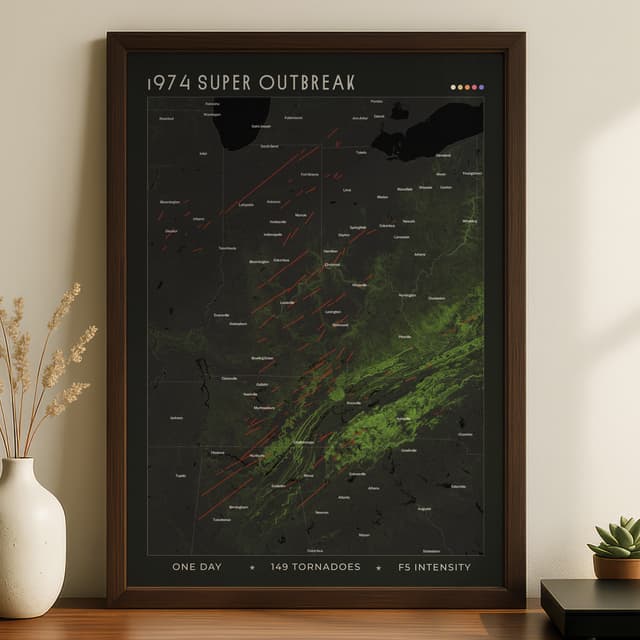
Fujita's methodology was remarkably hands-on. After major tornado events, he would charter small aircraft and fly over the damage paths, photographing and mapping the destruction in meticulous detail. His aerial surveys of the 1974 Super Outbreak remain among the most comprehensive damage assessments ever conducted. He personally mapped hundreds of miles of tornado tracks from that single event.
What set Fujita apart was his ability to read damage patterns. He could examine the debris field of a destroyed neighbourhood and reconstruct the wind patterns that caused the destruction. He identified the existence of multiple vortices within a single tornado based on the swirling damage patterns they left on the ground. His observations were decades ahead of what instruments could confirm.
The Original Scale: F0 to F5
Fujita introduced his tornado intensity scale in 1971. It classified tornadoes into six categories based on estimated wind speeds and the damage those winds would produce.
F0 (40-72 mph) — Light damage. Broken branches, damaged signs, shallow-rooted trees pushed over. These are the most common tornadoes and often go unreported in rural areas.
F1 (73-112 mph) — Moderate damage. Roof surfaces peeled off, mobile homes pushed off foundations, moving vehicles pushed off roads.
F2 (113-157 mph) — Significant damage. Roofs torn from frame houses, large trees snapped or uprooted, light objects become airborne missiles.
F3 (158-206 mph) — Severe damage. Entire stories of well-constructed houses destroyed, trains overturned, heavy vehicles lifted and thrown.
F4 (207-260 mph) — Devastating damage. Well-constructed houses levelled. Structures with weak foundations blown considerable distances. Large missiles generated.
F5 (261-318 mph) — Incredible damage. Strong frame houses lifted from foundations and carried. Automobile-sized missiles fly through the air for distances exceeding 100 metres. Trees debarked.
The 1974 Super Outbreak was the event that gave Fujita the dataset to validate this scale comprehensively. Seven F5 tornadoes in a single day, alongside dozens of storms across every other rating, provided an unprecedented range of damage data to work with.
The Enhanced Fujita Scale
In 2007, the United States replaced the original Fujita Scale with the Enhanced Fujita Scale (EF Scale). The revision was driven by decades of engineering research into how different types of structures fail under wind loading.
The original scale had a fundamental problem: it assumed a direct relationship between wind speed and damage that did not account for construction quality. A well-built house and a poorly-built house experience the same wind differently. The EF Scale addressed this by introducing 28 specific Damage Indicators, building types and structures with known failure characteristics, each with Degrees of Damage that correspond to estimated wind speeds.
The EF Scale ratings run from EF0 to EF5, but the wind speed ranges were revised downward slightly based on the engineering data. An EF5 begins at 200 mph rather than the original F5 threshold of 261 mph. This does not mean tornadoes became weaker. It means the engineering analysis showed that the damage previously attributed to higher wind speeds could be produced by somewhat lower speeds than Fujita originally estimated.
Many countries still use the original Fujita Scale, and all historical tornado data prior to 2007 uses F ratings. When comparing events across eras, this distinction matters.
The Limitations of Damage-Based Rating
The Fujita Scale and the EF Scale both rate tornadoes by their damage. This means a tornado's official rating is determined by what it hits, not by what it is actually capable of.
The El Reno tornado of 2013 is the clearest example of this limitation. It was officially rated EF3 based on the structural damage it caused. But mobile Doppler radar measured wind speeds within the tornado that likely exceeded 300 mph, well into EF5 territory. The discrepancy exists because the tornado spent most of its time over open farmland. There were no structures for it to destroy, so there was no damage to rate.
A tornado that tracks across open fields may be rated F0 or EF0 despite having the wind speeds of a far more intense storm. A tornado that strikes a town with poorly constructed buildings may receive a higher rating than one that hits well-engineered structures of the same wind speed. The scale measures effect, not cause.
This matters for understanding historical data. When someone says a particular region has never experienced an F5 tornado, it might be more accurate to say that an F5-rated damage event has never been documented there. The tornadoes in the fields may have been just as powerful. They simply left no evidence to rate.
Why the Scale Still Matters
Despite its limitations, the Fujita Scale and its Enhanced successor remain the standard framework for talking about tornado intensity. They provide a shared vocabulary that connects meteorologists, emergency managers, and the public. When a forecaster says an EF4 hit a community, everyone understands the approximate severity.
Ted Fujita did not just create a numbering system. He built the intellectual framework for understanding how tornadoes interact with the built environment. His name on the scale represents decades of painstaking research conducted by a scientist who flew over disaster zones with a camera and a notebook and figured out what the winds were doing based on what they left behind.
The 1974 Super Outbreak gave him the data. The scale gave the rest of us the language.